

Solar‑powered street lighting has become a go‑to sustainable solution for highways, rural communities, suburban access roads and remote public spaces worldwide. Free from costly grid cabling and civil trenching work, these all‑in‑one fixtures deliver affordable, clean illumination to locations that were historically underserved by conventional mains‑fed lighting infrastructure.
Yet a critical operational gap undermines thousands of completed solar lighting installations across global markets. Once installed and handed over, many solar streetlights turn into forgotten assets, operating completely out of sight for municipal operators, project contractors and asset owners.
Without remote digital visibility, operators have no practical way to verify real‑world fixture performance. They cannot confirm whether each light switches on reliably at dusk, maintains consistent full‑night illumination, sustains unseen physical damage from vehicle impact or human tampering, or suffers complete hardware theft.
Sending field crews out to conduct regular nightly on‑site inspections across large, geographically dispersed networks comes with prohibitive labour, fuel and logistics costs. For most public and private operators, running routine physical patrols to check every single light pole is simply economically unfeasible.
Hidden Safety & Financial Risks of Unmonitored Solar Lighting
This widespread blind‑spot in asset management creates tangible public‑safety risks for local communities. Failed, flickering or dimmed solar lamps create unanticipated dark roadway sections for pedestrians, cyclists and passing vehicles, elevating risks of traffic accidents and personal‑security threats after dark.
Vandalised or stolen fixtures can leave whole stretches of public space unlit for days or even weeks, with issues only uncovered through random resident complaints. Valuable public and private capital investment is silently lost through stolen solar panels and high‑grade battery packs, with no real‑time means to detect incidents the moment they happen. Worse still, project owners struggle to validate whether their large‑scale solar lighting investment actually meets contracted safety, operating and sustainability targets.

E‑Lite iNET IoT Ecosystem: Centralised Remote Monitoring & Control
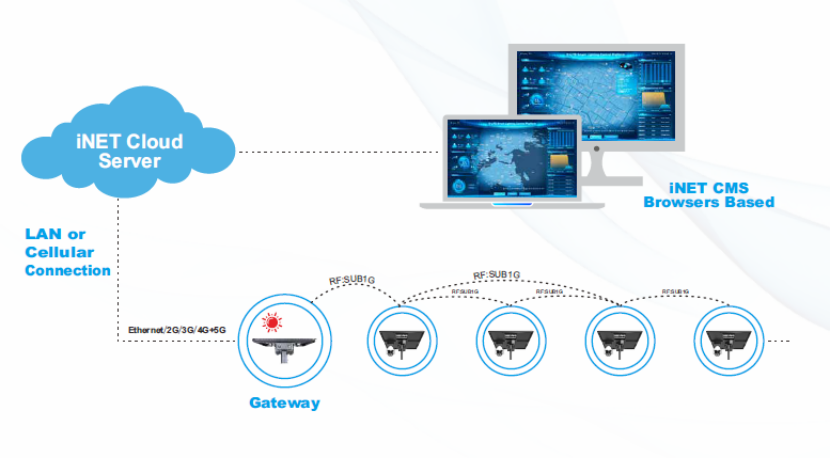
E‑Lite Semiconductor solves these long‑standing industry pain points with its proprietary iNET IoT cloud ecosystem, purpose‑built for solar and hybrid street‑light deployments.
The platform brings every connected luminaire under unified digital supervision, removing heavy dependence on end‑user complaints or unnecessary blind site visits. Through an intuitive web‑based central dashboard, operators are able to:
- Monitor real‑time operational status for every individual light unit: battery health, solar charging performance, LED working condition and cumulative operating hours
- Remotely customise lighting schedules and multi‑stage dimming profiles, without dispatching technicians to the field
- Receive instant system‑generated fault alerts, enabling targeted maintenance work instead of wasteful full‑network physical patrols
Unlike many third‑party add‑on IoT solutions assembled from mixed‑source components available on the market, E‑Lite delivers a fully in‑house hardware‑software stack with battery‑data accuracy higher than 95 %, effectively avoiding distorted and unreliable readings caused by mismatched outsourced parts.
Smart Anti‑Theft & Damage‑Alert Functions for High‑Risk Zones
For project sites vulnerable to theft, vandalism and frequent traffic collisions, E‑Lite adds dedicated smart sensing hardware for enhanced asset protection.
GPS geo‑tracking enables continuous real‑time location monitoring. If a fixture is removed and displaced, the cloud platform triggers immediate alarms so security and maintenance teams can respond promptly before assets disappear completely.
Complementing GPS tracking, the AI‑enabled tilt‑detection sensor identifies abnormal angle shifts caused by vehicle crashes, attempted theft or fixture dropping. Alerts are pushed to the operation centre the moment physical damage occurs. Rather than discovering infrastructure failure several days after an incident takes place, technicians can attend the scene right away, reducing public‑safety exposure and limiting overall asset losses.
Conclusion: IoT Is No Longer Optional for Solar Street Lighting Projects
Solar street lighting can only deliver its full expected return on investment when field performance is continuously traceable, equipment faults are captured at an early stage, and expensive core hardware is well‑protected.
Deploying solar lamps without IoT remote management leaves real‑world project performance entirely to chance. Integrated IoT functionality has evolved from a nice‑to‑have optional upgrade into an essential project requirement. It safeguards public safety, optimises long‑term maintenance budgets, secures valuable capital assets, and guarantees lasting project value for municipalities, contractors and project investors.
E-Lite Semiconductor Co., Ltd
Email: hello@elitesemicon.com
Web: www.elitesemicon.com
Post time: Sep-20-2026


