
When drafting procurement specs for solar street lighting projects, many engineers and buyers routinely write line items like: “Requirement: 150W Solar Street Light — 500 Units.”
In the era of traditional AC grid lighting, relying on wattage as a proxy for brightness worked reasonably well. In off-grid solar systems, however, wattage only measures energy consumption—lumens measure the light you actually buy.
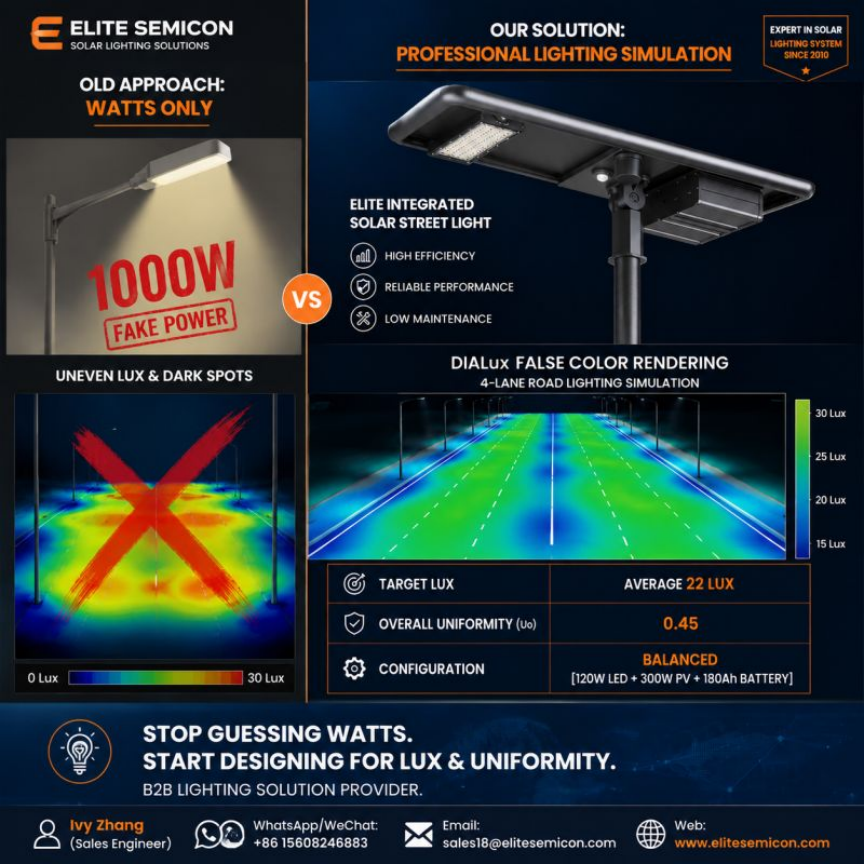
Focusing solely on higher wattage rather than system luminous efficacy (lm/W) leads to poor illumination levels on the road and forces system design into a cascading cycle of inflated component costs, driving up your total cost of ownership (TCO).
The Math: Why 100W Beats 150W
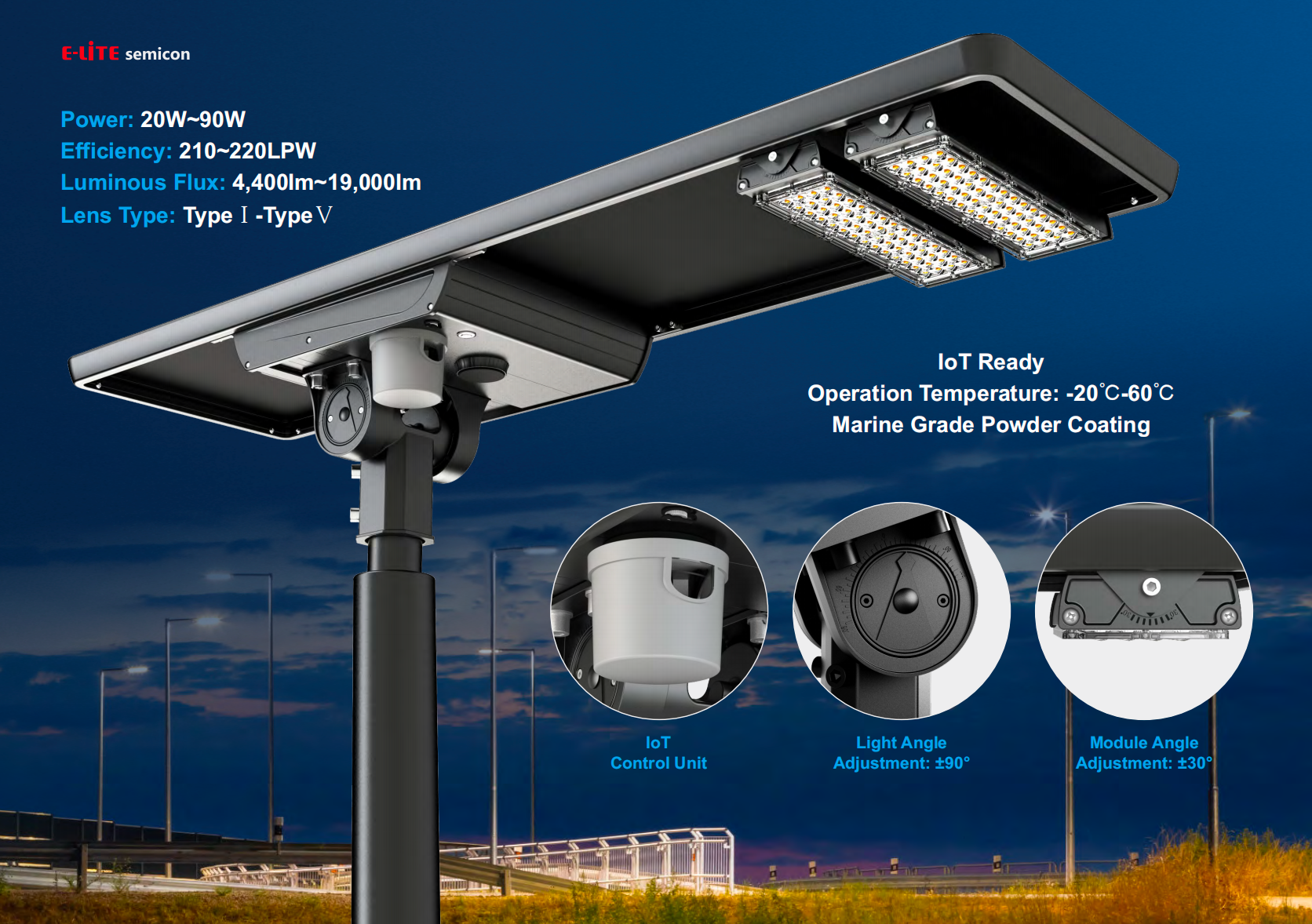
To understand how efficacy dictates system costs, compare a standard market fixture against advanced engineering options like the E-Lite Solara:
- · Standard Luminaire A: Rated at 150W using basic LEDs (~130 lm/W) → Total Output: ~19,500 Lumens
- · E-Lite Solara: Rated at 100W using high-grade Philips Lumileds LEDs (210–213 lm/W) → Total Output: ~21,000 Lumens
The 100W luminaire outshines the 150W competitor while consuming 33% less energy per night.
The Domino Effect: System-Wide Cost Savings
A jump to 210+ lm/W does far more than reduce power consumption—it creates a multi-tier saving effect across your entire project budget:
- · Reduced Battery Expenditure: Lower nightly power draw eliminates the need for massive battery banks. Equipping fixtures with Grade A+ LiFePO4 battery chemistry achieves long service lifespans at an optimized capacity footprint.
- · Smaller Solar Panels & Reduced EPA: Drawing less power allows for a compact monocrystalline solar panel design (23% conversion efficiency). Shrinking the panel minimizes the Effective Projected Area (EPA)—the key variable driving wind resistance calculations.
- · Lower Pole & Foundation Costs: A lower wind load (EPA) means you don’t need reinforced, extra-thick steel poles or deep concrete foundations. Standard structural poles will comfortably handle high wind speeds, saving thousands in structural engineering and freight.
How to Draft Better Tender Specifications
To avoid low-efficacy traps in your procurement tenders:
- ✓ · Specify Efficacy over Power: Never specify “100W solar light” alone. Require “Complete Luminaire Efficacy ≥ 210 lm/W” backed by accredited lab test reports.
- ✓ · Require Photometric Layouts: Ask vendors for IES files and DIALux simulations to ensure optics target the roadway without wasted spill light.
- ✓ · Demand Smart Energy Management: Ensure luminaires include precision lenses and microwave/radar dimming sensors to stretch battery capacity through off-peak hours.
Optimize Your Solar Lighting Project
True engineering value isn’t about buying the highest wattage for the lowest unit price—it is about choosing efficient components that deliver the lowest overall system cost.
Planning an upcoming solar street lighting project? Send us your lux requirements or road parameters. The engineering team at E-Lite Semiconductor will provide a complimentary DIALux simulation report and customized ROI cost calculation to show you exact savings.
Post time: Sep-04-2026


