
In the rapidly evolving field of sustainable urban infrastructure, solar street lights have transitioned from a supplementary option to a core lighting solution. However, not all solar lights share the same design intent. The industry is currently witnessing a significant shift from “fixed” designs to adjustable systems. As engineers, we must ask: when solar paths and road environments are dynamic, why should we settle for static mounting positions? This article will explore why adjustable LED solar lights, represented by the Talos all-in-one solar street light, can far outperform traditional fixed systems in overall performance through these four aspects: maximizing photovoltaic conversion efficiency, ensuring precise light distribution and compliance with “Dark Sky Standards,” adapting to complex urban terrains, and optimizing thermal management and service life.
Maximizing Photovoltaic Efficiency
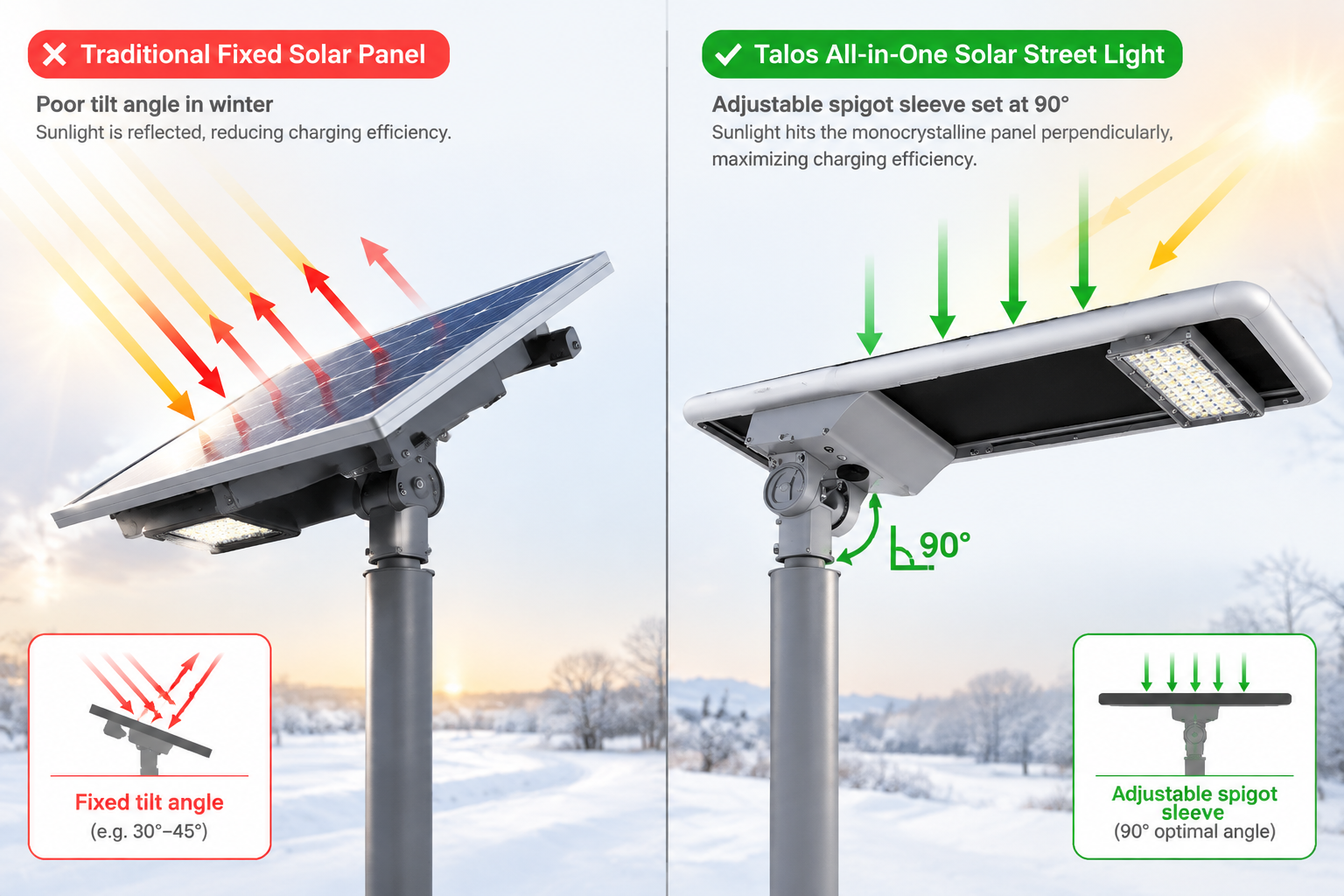
The primary limitation of any solar lighting system is its ability to harvest energy. Fixed systems are often installed at a compromise angle to simplify manufacturing, leading to a significant drop in power generation depending on the latitude and local topography.
The Talos Integrated Solar Street Light system solves this problem with its 0–90°adjustable Slip Fitter. By allowing the entire fixture to be tilted precisely toward the solar noon position based on specific site coordinates, we can enhance energy absorption by up to 25% compared to fixed-angle imports. This ensures that the high-grade monocrystalline silicon solar panels (delivering 23-24% efficiency) operate at their peak potential year-round, even in high-latitude regions where the winter sun is low.
Precision Light Distribution and “Dark Sky” Compliance
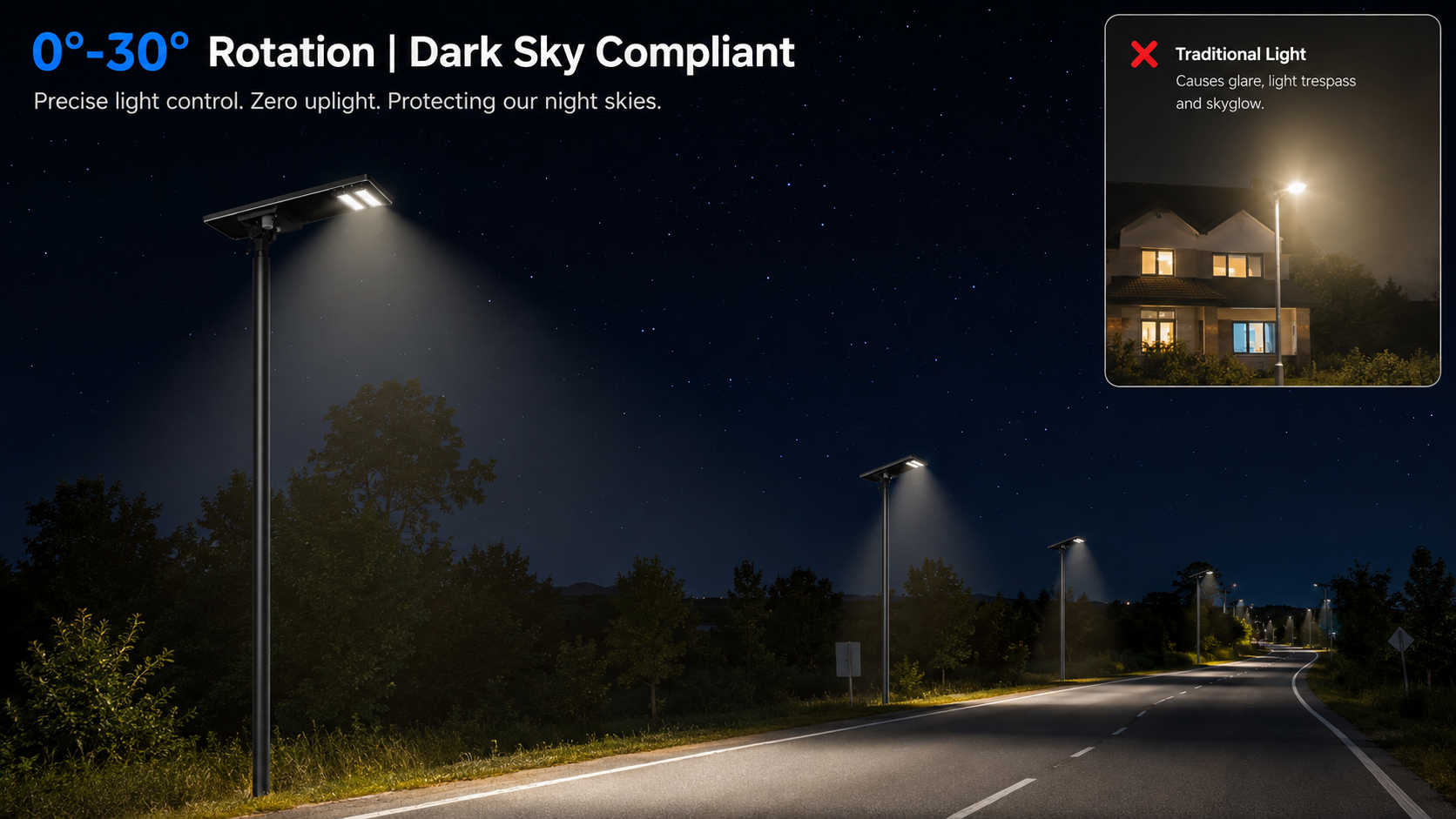
A fixed solar light often wastes a significant portion of its output. If the pole isn’t perfectly positioned, the light spills into residential windows or dissipates into the atmosphere—a phenomenon known as light pollution.
Adjustable systems like the Talos Integrated Solar Street Light system are equipped with rotatable LED modules, offering an adjustment range of 0° to 30°. This allows engineers to precisely ‘aim’ the light beam at the exact areas that require illumination, Utilizing Philips Lumileds chips and high-efficiency optics (210-220 lm/W), Solara Integrated Solar Street Light system ensures uniform roadway illumination while remaining strictly”Dark Sky compliant”. This level of control is impossible with fixed modules that offer no post-installation correction.
Adapting to Complex Urban Topography
No two installation sites are identical. Roadways have curves, ramps, and varying widths. Fixed systems require a “one size fits all” approach that often leads to dark spots or over-lit areas.
With advanced IoT Smart Management,Talos Integrated Solar Street Light system complements its physical adjustability with digital intelligence. The AI-enabled tilt alarm and GPS tracking ensure that once the optimal angle is set, any unauthorized tampering or environmental shift (like pole leaning) is immediately reported to the central operation center.
Thermal Management and Longevity
Fixed horizontal designs often accumulate dust, snow, and bird droppings more easily, which creates “hot spots” on the solar cells and reduces the lifespan of the battery. The ability to angle the Talos Integrated Solar Street Light system helps in natural debris runoff. Furthermore, our use of Grade A+ LiFePO4 batteries (2000-5000 cycles) combined with a professional MPPT controller ensures that the energy harvested through optimized angles is stored and used with maximum efficiency.
Conclusion
The transition to adjustable solar lighting is not just a trend; it is a necessity for high-performance infrastructure. The Talos Integrated Solar Street Light system series by E-Lite Semiconductor Inc provides the flexibility required to meet modern lighting standards while slashing energy waste. For project managers looking for a future-proof solution, the choice is clear: adjustability is the key to achieving superior performance.
E-Lite Semiconductor Co., Ltd
Email:hello@elitesemicon.com
Web:www.elitesemicon.com
Post time: Sep-28-2026


